- CALL : 0800 193 6323
- Support : 0844 334 4469
- Uncategorised
- Oct 07
Why Isn’t Your Affiliate Attribution Working?
Ask three people in the same business how much the affiliate channel made last month & you’ll usually get three answers.
The network dashboard says one number. GA4 says a smaller one. Finance looks at the bank & quietly wonders whether either is real.
Most brands take that as proof that affiliate attribution is ‘broken’. In our experience it isn’t broken – it’s answering a different question to the one you’re asking. Attribution tells you who got the credit. What you actually want to know is who caused the sale. Those aren’t the same thing, & the gap between them is where a lot of affiliate budget quietly disappears.
After 11 years of running affiliate programs for UK brands, here’s why we think your attribution isn’t working – & what we do about it.
Every Tool Is Marking Its Own Homework
Your affiliate network tracks the sales its partners touched. GA4 tracks sessions it can see & assigns credit using its own rules. Your ecommerce platform records orders. None of them are lying – they’re just measuring from different seats in the stadium.
The trouble starts when one of them is treated as ‘the’ source of truth. Internally, that’s often the network, because it’s what commission is paid on. But a network will happily credit a partner who appeared at the very end of the journey, even if the customer had already decided to buy.
So the first job isn’t to pick the right number. It’s to understand why the numbers differ – rather than simply reporting the one that looks best for the channel.
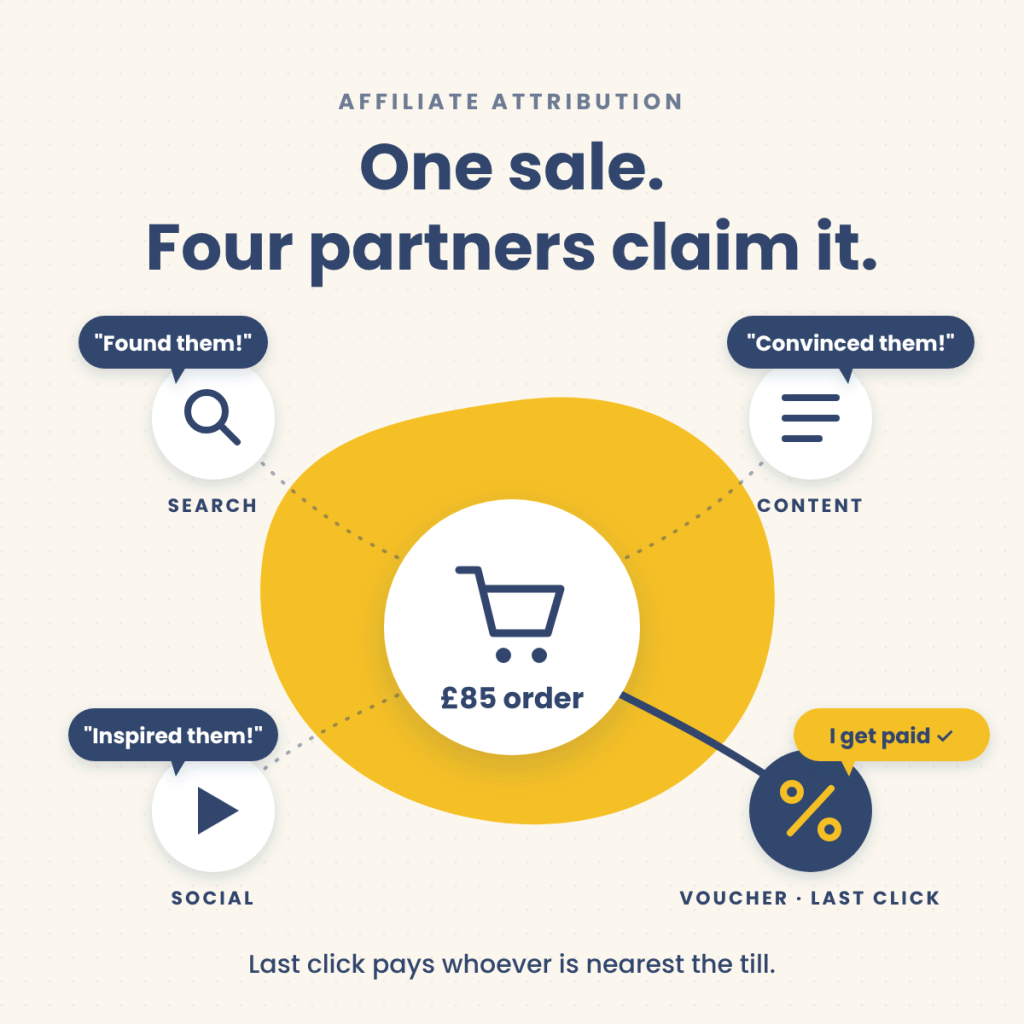
Last Click Rewards Whoever Turns Up At The Till
Most affiliate programs still pay on last click. The industry has talked about multi-touch for years, but the reality is slower to change. Speaking about the 2025 State of the Affiliate Nation report, Kevin Edwards noted that only around one in eight pounds tracked through the UK affiliate channel goes on ‘non-last click CPA’ activity.
Last click isn’t evil. It’s simple, it’s cheap to run & it’s easy to explain to a finance director. But it does have a habit – it rewards whoever is standing nearest the checkout. That’s often a voucher code site, a cashback portal or a browser extension that pops up as the customer is about to pay.
We saw this with a UK home improvement retailer. Around 40% of their affiliate revenue ran through cashback & sub-networks that couldn’t tell us where their traffic came from. On paper the program looked healthy. In practice, we suspected a big chunk of that revenue would have happened anyway.
Rather than switch it off overnight – which would’ve looked like a disaster, owing to the network being the source of truth internally – we used URL reports to pin point the ‘trouble’ making affiliates, phased them out gradually & recruited quality content & loyalty partners to replace them.
This resulted in a 22.5% increase in YoY revenue, a 19% reduction in costs & a net ROI gain of 41.5%.
Less revenue we didn’t need to pay for. More of the revenue we did.
Your Partners Are Labelled Wrong
This one surprises people. Attribution is only as good as the labels sitting underneath it.
A global games & consoles brand came to us convinced their content partners were doing the heavy lifting. They weren’t – or at least not as much as the reports said. Content was being over-reported on Awin owing to affiliates being mislabelled, so partners that weren’t really content, were showing up under ‘content’.
Every decision that built on that data (commission rates, budget, which partners got a seat at a big console launch) were being made on the wrong picture.
The program moved to Impact.com, we then fixed the tagging & built genuine editorial affiliates into the brand’s existing live events, rather than running a separate affiliate calendar alongside them.
This resulted in a 331% increase in YoY revenue, with 82% coming from genuine content.
No new attribution model required. Just honest labels.
Clicks Aren’t A Proxy For Value
If you’re judging partners on traffic, your attribution will flatter the noisiest ones.
Looking back at the year so far for a refurbished tech client, March brought in roughly 4x a typical month’s clicks… & one of the lowest revenue months of the year. Revenue per click in March was £0.98. In August it was £6.46.
Same program, same network. Very different partners driving the traffic.
By leaning into the partners that convert rather than the ones that click, the program has delivered £180k from 711 orders, revenue is up 71% from January to August & every £1 invested is returning £12.64.
Leads Are Where Affiliate Attribution Gets Really ‘Creative’
Lead gen programs have it worse. Pay on a form fill, approve automatically & let sub-networks in, & you’ve built a machine that rewards volume, not customers.
A car leasing client launched & saw leads flying in from day one. Brilliant – until we looked at the URL reports. High volume, last click, sub-networks & auto-approval on a lead based setup. In our experience that combination usually spells ‘suspect’.
We extended the locking period so leads could be checked before being paid, removed the sub-networks that couldn’t show us their traffic & recruited quality partners to replace the ‘lost’ volume.
This resulted in a 62% drop in low-quality lead costs & a 31% increase in bottom-line revenue. The in-network numbers looked worse for a while. The business looked better.
The Tracking Itself Is Getting Leakier
There’s also a plain technical reason the numbers don’t line up. Safari has been tightening cookies for years – in some cases capping script-set cookies at just 24 hours when a visitor lands from a tracking link. Ad blockers & consent banners knock out more.
Meanwhile, the tools have narrowed. Google retired first click, linear, time decay & position-based models from GA4 in 2023, leaving last click & data-driven. And after years of telling everyone third-party cookies were going, Google retired most of its Privacy Sandbox replacement tech in October 2025 – including the Attribution Reporting API – with cookies staying put in Chrome.
None of that is a reason to panic. It’s a reason to stop expecting any one dashboard to give you a perfect answer.
What We’d Check First
If your numbers don’t add up, start here:
- Reconcile the three sources monthly. Network vs GA4 vs backend orders. Don’t force them to match – write down why they differ & watch whether the gap is growing.
- Run URL reports on your biggest partners. If a partner can’t show you where their traffic comes from, that’s your answer.
- Audit your partner labels. Is ‘content’ really content? Are sub-networks hiding traffic you can’t see underneath?
- Pay for the behaviour you want. Lower or tiered commission for partners that only appear at the till, better rates & ‘tenancy’ for partners that introduce new customers.
- Test incrementality, don’t assume it. Pause or hold out a partner for a set period & watch what happens to total sales – not just affiliate sales.
Why We Care About This More Than Most
As a fixed-fee agency, we have no reason to push volume for the sake of it. If cutting a partner loses the channel revenue but makes the business money, that’s a good month for us.
That mindset is a big part of why we’re founding members of the APMA & why we won the PMA Best Managed Affiliate Programme (SME) award in 2024. Your attribution doesn’t need to be perfect. It just needs to be honest enough to spend money on.
Want To See How You Stack Up?
We’re offering UK ecommerce brands a free Competitor Affiliate Benchmark. We’ll look at your affiliate setup alongside your closest competitors – who they work with, where they’re showing up & where you’re missing out – & send you the findings, no strings attached.
Drop us a message through thoughtmix.com & we’ll get yours started.
Sources
- State of the Affiliate Nation highlights, Kevin Edwards at PMW Unlocked – APMA, Mar 2026
- Google removes first click, linear, time decay & position-based models – Search Engine Land
- Google is retiring Privacy Sandbox – BetaNews, Oct 2025
- Intelligent Tracking Prevention 2.3 (24-hour cookie cap after link decoration) – WebKit