- CALL : 0800 193 6323
- Support : 0844 334 4469
- Strategy Uncategorised
- Nov 02
Is Affiliate Attribution a Con? An Honest Answer
Over the last two weeks we’ve written about why attribution so often ‘isn’t working’, & what the real benefits are when it does. That leaves the more awkward question – the one finance teams are right to ask. Is attribution a con?
Our honest answer after 11 years & hundreds of affiliate programs: no. But it’s very easy to game, & the people who report it to you often benefit from the number they’re reporting. That’s not a con on its own. It just means you shouldn’t take any single figure at face value.
Who’s marking the homework?
Every platform you use reports its own credit. Your network shows what it tracked. Your ad platforms show what they tracked. Publishers show what their links touched. Each one sees part of the journey & nobody sees all of it – so add them together & you’ll usually have ‘sold’ more than you actually did.
Then there’s the default rule most affiliate programs run on: last click. Whoever drops the last cookie before checkout gets 100% of the commission. It’s simple & cheap to run, but it rewards being last, not being useful. And anything that rewards being last will attract people who are very good at being last.
What attribution gaming looks like in practice
The clearest recent example is PayPal’s Honey extension. Allegations surfaced in December 2024 that it was diverting affiliate commissions – stepping in at checkout & taking credit for sales that other partners had driven. On 21 January 2026 – www.awin.com – confirmed Honey had violated its publisher policies through commission diversion. It suspended Honey’s payments & blocked it from joining new advertiser programs.
As part of the fix, Honey agreed to give networks access to relevant source code, to let advertisers manage which coupon codes it shows (including removing ones they never authorised) & to give networks notice before changing its attribution or ‘stand-down’ logic.
Google had already moved on the wider problem. Its Chrome Web Store policy, announced in March 2025 & in force from 10 June 2025, says extensions can only use affiliate links, codes or cookies when they give the user a direct, transparent benefit. A coupon extension, for example, mustn’t insert an affiliate link when it hasn’t found a discount.
None of this means browser extensions or cashback sites are ‘bad’. Plenty do a real job for retention & conversion. It means the tracking can only tell you who was there at the end – not whether they made any difference. As founding members of the APMA, transparency here is something we’ve pushed for a long time.
When volume looks like success
Gaming isn’t always as dramatic as an extension. Sometimes it’s just a setup that pays for the wrong thing.
A car leasing lead generation client launched on Impact.com & saw leads fly in from day one. Brilliant – until we looked at the URL reports. High volume, last click, sub-networks & auto-approval on a lead-based program. In our experience that combination usually spells ‘suspect’.
We extended the locking period so leads could be checked before being paid, removed the sub-networks that couldn’t show us where their traffic came from & recruited quality partners to replace the ‘lost’ volume.
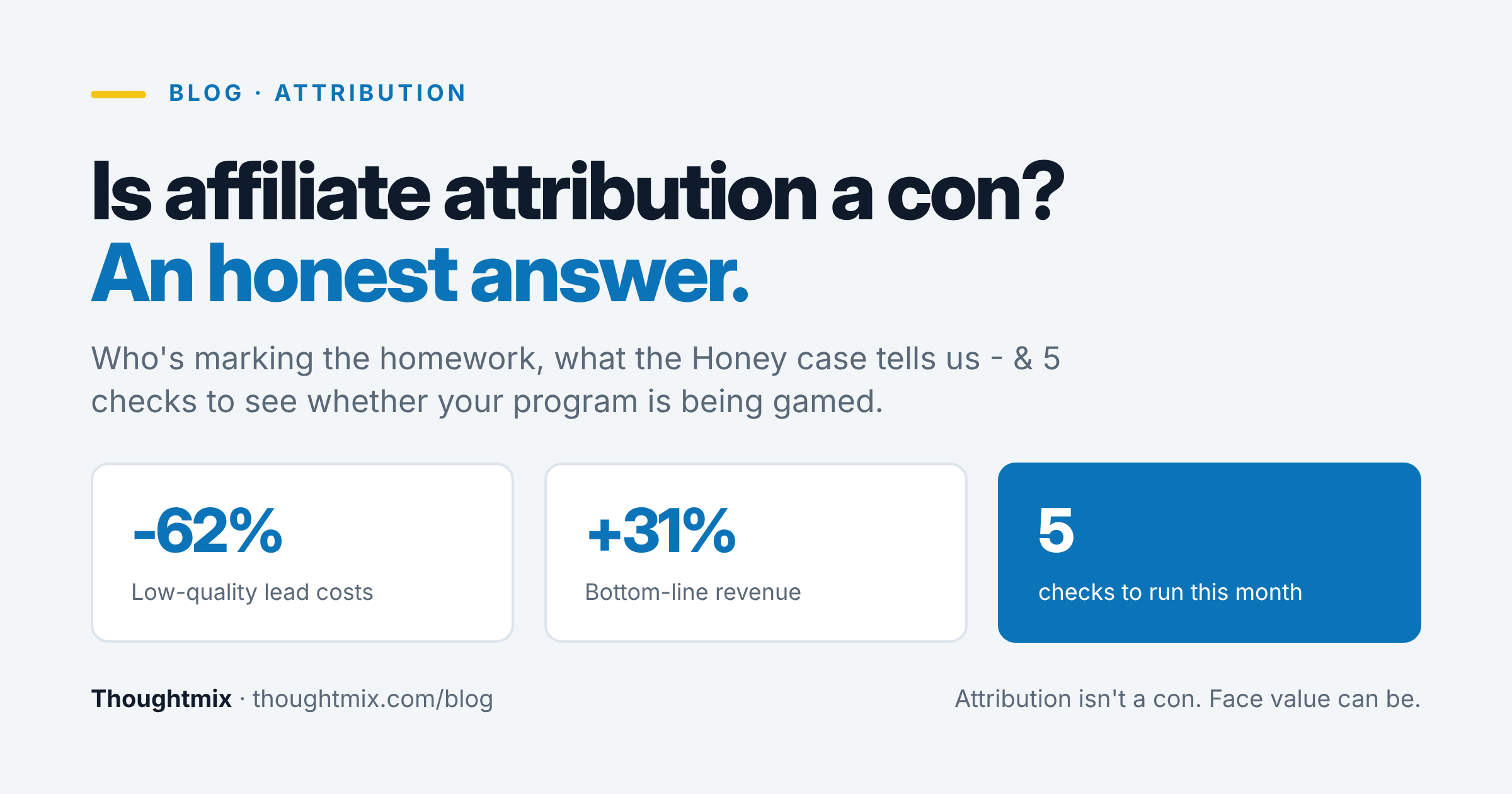
This resulted in low-quality lead costs down 62% & bottom-line revenue up 31%.
The in-network numbers looked worse for a while. The business numbers looked a lot better. That gap is exactly where people start asking whether attribution is a con – when the honest answer is that the attribution was never the problem. Paying for every lead it reported was.
Clicks aren’t credit either
The other trap is treating activity as contribution. For one of our refurbished tech clients, March brought in roughly 4x a typical month’s clicks – one of the lowest revenue months of the year. Revenue per click was £0.98 in March against £6.46 in August.
Same program, same network, very different partners driving the traffic. By leaning into the partners that convert rather than the ones that click, revenue is up 71% since January & every £1 invested is returning £12.64.
If you’d judged that program on reported clicks, March would’ve looked like a triumph.
So what isn’t an attribution con?
Attribution works when you stop asking one tool for the truth & start comparing several.
- Your network tells you which partners touched a sale & when
- GA4 & your own backend tell you what actually landed & usually disagree with the network – that disagreement is useful
- Marketing mix models like Fospha, or Google’s open-source Meridian (made available to everyone in January 2025), look at the channel from the outside rather than counting clicks
None of these is ‘right’ on its own. Line them up & write down why the numbers differ, rather than simply reporting the one that looks best for the channel. That’s where most of the useful decisions come from.
How to check whether your programs attribution is being gamed
You don’t need a new tool to start. Over the next month:
- Pull a URL report & look for partners whose sales cluster at the final step, often minutes before checkout
- Ask any sub-network to show you where its traffic comes from – if it can’t (or won’t), that’s your answer
- Check whether codes you never gave out are appearing on extension & voucher sites
- On lead-based programs, make sure there’s a locking or validation period before anything is paid
- Compare network-reported revenue with your backend for the same period & find out what explains the gap
Why we tell you
As a fixed-fee agency, we’ve no reason to push volume for the sake of it. If a chunk of your affiliate revenue is being claimed rather than created, we’d rather say so & fix it – even when that makes the in-network numbers dip for a few months. Attribution isn’t a con. Taking it at face value can be.
Want to see how you compare?
We’re offering UK ecommerce brands a free Competitor Affiliate Benchmark. We’ll look at how your affiliate setup stacks up against your closest competitors – which partners they’re working with, where they’re visible & you’re not, & where you might be paying for sales you’d have had anyway. No obligation, & no ‘you need a total rebuild’ pitch at the end.
Get in touch through thoughtmix.com or message Tommy on LinkedIn & we’ll put yours together.
Sources
Related Posts
Why Isn’t Your Affiliate Attribution Working?
Hot takes on Affiliate Marketing Attribution, common mistakes, and how we fix them

- Oct 07
Meet the new Managing Director at ThoughtMix
We have kickstarted 2025 with an exciting new addition to the team – Jonathan Cropley who will be stepping into the role of Managing Director for both ThoughtMix and Distract. Jonathan has a successful history…
- Feb 26