- CALL : 0800 193 6323
- Support : 0844 334 4469
- Performance
- Oct 21
What Are the Benefits of Using Affiliate Attribution?
Last week we wrote about why most brands’ affiliate attribution ‘isn’t working’. The obvious follow-up question is: so why bother with attribution at all?
Fair question. Here’s our honest answer after 11 years & hundreds of affiliate programs. Attribution won’t give you one perfect number. Nothing will. What it does give you is the ability to make better decisions about who you pay, how much & for what job. That’s where the money is.
First, what affiliate attribution is (and isn’t)
Affiliate Attribution is just the set of rules that decides which touchpoint gets the credit for a sale. Most affiliate networks default to last click – whoever dropped the last cookie before checkout gets 100% of the commission.
It’s worth knowing how narrow the wider industry has made the options. In June 2023 Google removed first click, linear, time decay & position-based models from GA4, leaving only last click & data-driven. Google’s reason was that fewer than 3% of conversions in Google Ads used the models it removed. In other words, most brands never looked beyond last click in the first place.
GA4 isn’t a reliable judge of affiliates. Even Awin’s own guidance says it misses many affiliate touchpoints, so if it’s your source of truth, your content & creator partners are probably undervalued before you’ve started.
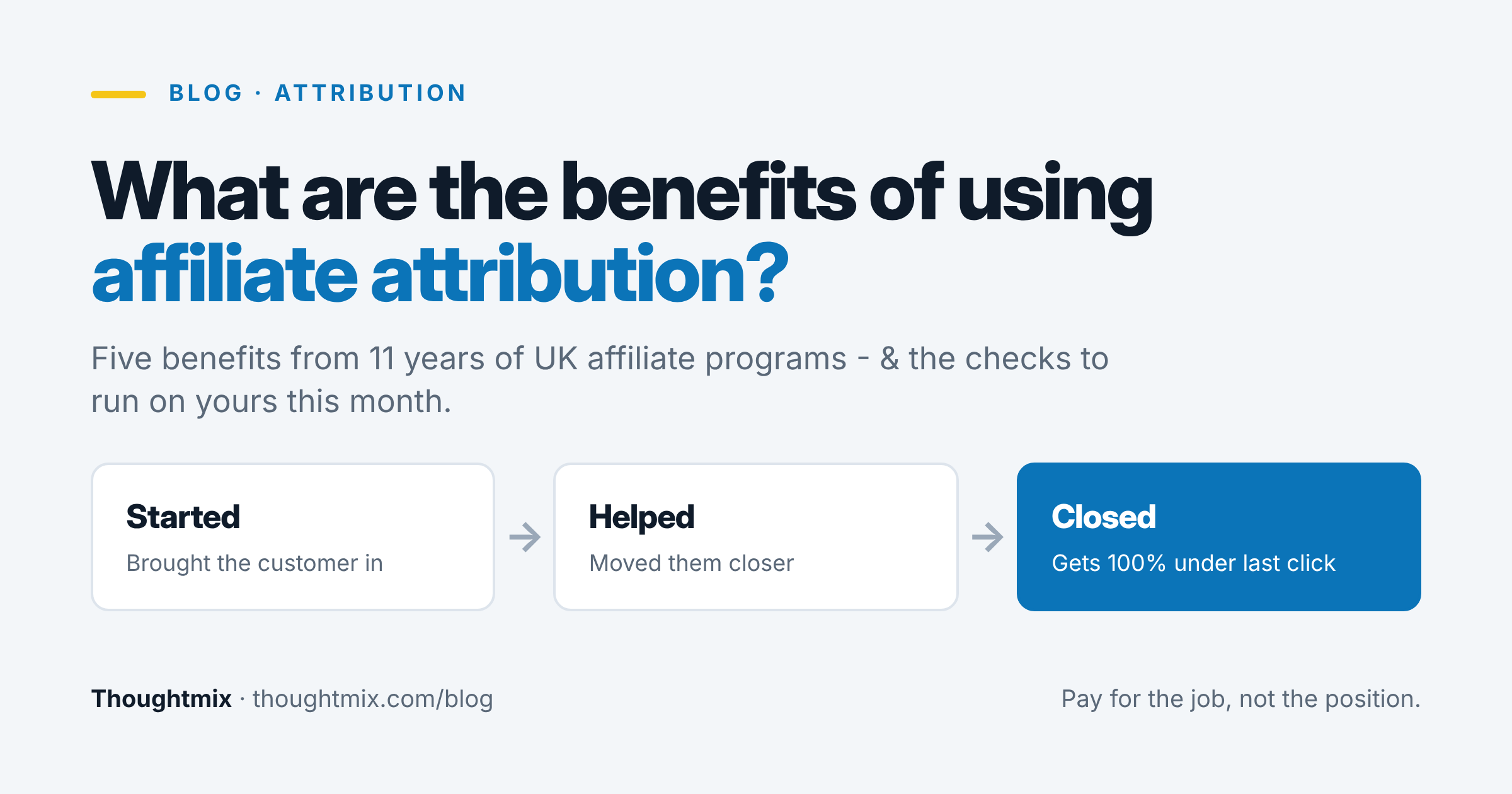
So when we talk about the benefits of attribution, we don’t mean picking a fancier model from a dropdown. We mean looking at the whole journey – who started it, who helped, who closed it – & then acting on what you find. Here’s what that’s done for our clients.
Benefit 1: you stop paying full commission for the last 30 seconds
The classic example is cashback & voucher sites sitting at the very end of the journey. They’re not ‘bad’ – loyalty partners do a real job, especially for retention. But under last click they’re paid the same rate whether they persuaded a new customer or simply caught someone who was already at the checkout.
A UK home improvement retailer came to us with around 40% of its affiliate revenue running through cashback & sub-networks. On paper the program looked healthy. The URL reports told a different story – a lot of that revenue was being claimed at the final step, by partners who couldn’t (or wouldn’t) show us where their traffic came from.
We didn’t rip it out overnight. Owing to the network being the source of truth internally, pulling that much revenue in one go would’ve looked like a disaster. Instead we phased out the low-quality affiliates gradually & recruited quality content & loyalty partners to replace the revenue before it disappeared.
This resulted in revenue up 22.5% YoY, costs down 19% & a net ROI gain of 41.5%.
That’s the first benefit in one line: you find the commission you never needed to pay.
Benefit 2: you know your partners are doing the job you think they are
Affiliate Attribution is only as good as the labels underneath it. If a partner is tagged as ‘content’ but behaves like a voucher site, every report built on top of it is wrong.
A global gaming brand’s reports showed a healthy share of revenue from content. Look closer & a chunk of it wasn’t content at all – affiliates had been mislabelled on Awin, so content was over-reported. We moved the program to Impact.com, fixed the tagging so every partner sat in the right bucket, then built editorial affiliates into the brand’s existing live events rather than running a separate affiliate calendar alongside them.
This resulted in revenue up 331% YoY, with 82% of it from genuine content.
No new affiliate attribution model was needed. Clean data showed us where to invest, & the brand could finally trust the content number when it went upstairs.
Benefit 3: you can reward the partners that start journeys
Once you can see the whole path, you can pay for the role a partner plays rather than just the position it finished in. Awin, for example, tracks an ‘initiator ratio’ (how often a partner started a sale it was involved in), ‘basket boost’ (the uplift in basket value when a partner takes part) & ‘conversion impact’ (how conversion rate changes when it’s involved). Its attribution performance report also flags ‘Solo’ conversions where no other channel was involved.
Those numbers make some very practical decisions possible:
- Higher commission for partners that bring in new customers, lower for those closing existing ones
- Tighter rules on voucher codes that don’t lift order value
- A case for keeping a content partner whose last-click revenue looks small but who keeps starting journeys
None of that needs a perfect model – just enough visibility to stop treating every sale as equal.
Benefit 4: you know which placements are worth paying for
Tenancies – fixed fees for a placement on a partner’s site or newsletter – are where affiliate attribution earns its keep. Without it, you’re paying upfront & hoping.
An FCA-regulated ISA provider came to us going head to head with a much bigger competitor for the same placements. Matching them pound for pound wasn’t an option. Instead we used flexible, ‘guerrilla’ tenancy booking – buying around the competitor’s key placements, at the moments that actually brought in new customers, rather than the slots that simply looked prestigious.
This resulted in ROI up 32%, revenue up 108% YoY & new customers up 125%.
Benefit 5: a straighter conversation with finance
Your network, GA4, your own backend & any marketing mix tool like Fospha will all give you a different number. That’s normal. The benefit of taking affiliate attribution seriously is that you can explain why they differ, rather than simply reporting the one that looks best for the channel.
It’s also worth clearing one thing up. Google confirmed in July 2024 that it wouldn’t phase out third-party cookies in Chrome after all, & in April 2025 it dropped the planned standalone choice prompt too. That’s not a reason to relax about tracking, but it does mean the ‘cookieless’ panic shouldn’t be what drives your attribution decisions. The bigger risk is the one most brands already have – paying the wrong partners for the wrong job.
As a fixed-fee agency, we’ve no reason to push volume for the sake of it. If the honest answer is that a chunk of your affiliate revenue isn’t incremental, we’d rather tell you – it’s part of why the team won the PMA Best Managed Affiliate Programme (SME) award in 2024.
Where to start this month with affiliate attribution
If you want the benefits without a six-month project, start here:
- Pull a URL report for the last three months & see which partners appear only at the final step
- Check partner tagging – are your ‘content’ partners actually content?
- Look at who starts journeys vs who closes them, if your network shows it
- Line up network, GA4 & backend numbers & write down why they differ
- Change one commission rule & measure it for a full quarter before changing the next
Want to see how you compare?
We’re offering UK ecommerce brands a free Competitor Affiliate Benchmark. We’ll look at how your affiliate setup stacks up against your closest competitors – which partners they’re working with, where they’re visible & you’re not, & where you might be paying for sales you’d have had anyway. No obligation, & no ‘you need a total rebuild’ pitch at the end.
Get in touch through thoughtmix.com or message Tommy on LinkedIn & we’ll put yours together.
Sources
- Google has removed attribution models in GA4 – Search Engine Land
- Google will keep third-party cookies in Chrome – SecurityWeek (July 2024)
- Google drops the standalone cookie choice prompt – AlternativeTo (April 2025)
- Understanding incrementality – Awin help centre
- Awin’s attribution performance report – Awin
Related Posts

5 key takeaways from Q4 data to shape 2024 affiliate marketing strategies
These are the five key takeaways to consider for 2024 affiliate marketing strategies as you look back on your Q4 data.

- Mar 11

Q4 affiliate marketing round-up: Consumer confidence grows despite 2023 cost-of-living crisis
These are the highest performing sectors in affiliate marketing in Q4 2023, including top insights for strategic decision making in 2024.
- Mar 04